Personal Trainer for an Aging Parent: What Adult Children Should Look For
Watching your parents get older can change the way you think about their health, strength, and independence.
Maybe you’ve noticed that your mother or father isn’t as active as they used to be. Perhaps they’ve mentioned feeling less confident about exercising, or you’ve noticed that everyday activities seem to require more effort.
You want to help, but you may not know where to start.
Should you encourage them to join a gym? Find a senior fitness class? Or consider hiring a personal trainer for elderly adults who can work with them individually?
I’m Doris Martinez, founder of DMM Fitness & Nutrition, and I work with seniors and older adults throughout the Central Savannah River Area (CSRA), including Augusta, Evans, Martinez, Grovetown, North Augusta, and surrounding communities.
One thing I believe strongly is that getting older doesn’t mean giving up on strength, movement, or an active lifestyle.
But choosing the right fitness professional for an aging parent involves more than finding someone who knows how to put together a workout.
Here’s what I encourage adult children and families to consider.
Why Consider a Personal Trainer for an Aging Parent?
As people age, maintaining muscle strength, balance, mobility, and physical activity can become increasingly important.
These abilities play a role in everyday activities such as:
- Getting up from a chair
- Walking and climbing stairs
- Carrying groceries
- Moving around the home
- Gardening and enjoying hobbies
- Participating in family activities
- Maintaining confidence with everyday movement
For some older adults, staying active comes naturally.
Others may find it difficult to maintain a consistent exercise routine, especially if they haven’t exercised regularly in years.
Working with a personal trainer for seniors can provide individualized guidance, encouragement, and accountability.
But there’s something important to understand.
Your parent doesn’t necessarily need easier exercise simply because they’re older. They need exercise that’s appropriate for their individual abilities.
That’s where specialized senior fitness training can make a difference.
1. Look for a Personal Trainer With Senior Fitness Qualifications
Not every personal trainer has the same education, experience, or areas of specialization.
When you’re searching for a personal trainer for older adults, one of the first things I recommend looking at is their professional background.
Do they have education related to senior fitness?
Do they understand how to modify exercises?
Can they work with different fitness levels?
Do they recognize that a healthy, active 75-year-old may need a completely different program from someone the same age who hasn’t exercised regularly in years?
My professional background includes:
- Senior Fitness Specialization
- Certified Personal Training
- Corrective Exercise Specialization
- Group Fitness Instruction
- Nutrition and Wellness
These areas help me approach senior fitness with an understanding of different abilities, movement needs, and individual goals.
A senior fitness specialist should never assume that everyone over 65 needs the same workout.
If you’d like to understand the role more fully, I’ve written about what a senior personal trainer does and whether one is right for you.
2. Choose Someone Who Personalizes the Fitness Program
One of the biggest advantages of private personal training is individual attention.
Your parent may want to improve strength.
They may be interested in balance and mobility.
Perhaps they want to return to regular exercise after several years away.
Or maybe they’ve always been active and want to continue challenging themselves appropriately.
A good personal trainer for elderly adults should begin by learning about the person, not immediately handing them a generic exercise routine.
When I work with an older adult, I want to understand:
- Their current fitness level
- Previous exercise experience
- Personal fitness goals
- Activities they enjoy
- Their comfort with different exercises
- Available space and equipment
- Individual limitations or considerations
- What they want to continue doing in everyday life
From there, I can determine an appropriate approach to their training.
Personal training should be personal, regardless of age.
3. Make Sure the Trainer Understands Strength Training for Seniors
Strength training isn’t just for younger adults or people who want to build large muscles.
Maintaining muscular strength is important for older adults because strength supports so many everyday activities.
Think about standing up from a chair, carrying laundry, climbing stairs, or picking something up from the floor.
These activities involve different muscle groups working together.
A trainer experienced in senior strength training can help older adults work on strength through exercises appropriate for their abilities.
Depending on the individual, training may incorporate:
- Body-weight exercises
- Resistance bands
- Dumbbells
- Modified squats or sit-to-stand movements
- Upper-body resistance exercises
- Functional strength exercises
The objective isn’t to make every workout extremely difficult.
It’s to provide the right amount of challenge.
I’ve discussed this further in Why Strength Training Becomes More Important as You Get Older.
And if you’re wondering how frequently your parent should exercise, my article How Often Should Seniors Strength Train to Stay Strong and Active? explains the importance of strength-training frequency, recovery, and consistency.
4. Ask Whether Balance, Mobility, and Functional Fitness Are Included
Strength is important, but it’s not the only component of healthy aging.
Balance, coordination, mobility, flexibility, and functional movement may also deserve attention.
For example, your parent may want to feel more comfortable:
- Moving around their home
- Getting in and out of a chair
- Walking on different surfaces
- Reaching for everyday objects
- Changing direction while walking
- Participating in recreational activities
A senior fitness trainer should understand how these physical abilities relate to everyday movement.
Depending on the individual’s goals, I may incorporate different exercises that challenge strength, balance, mobility, and coordination.
I believe exercise should have a purpose beyond simply completing repetitions.
Fitness should help support the life your parent wants to continue living.
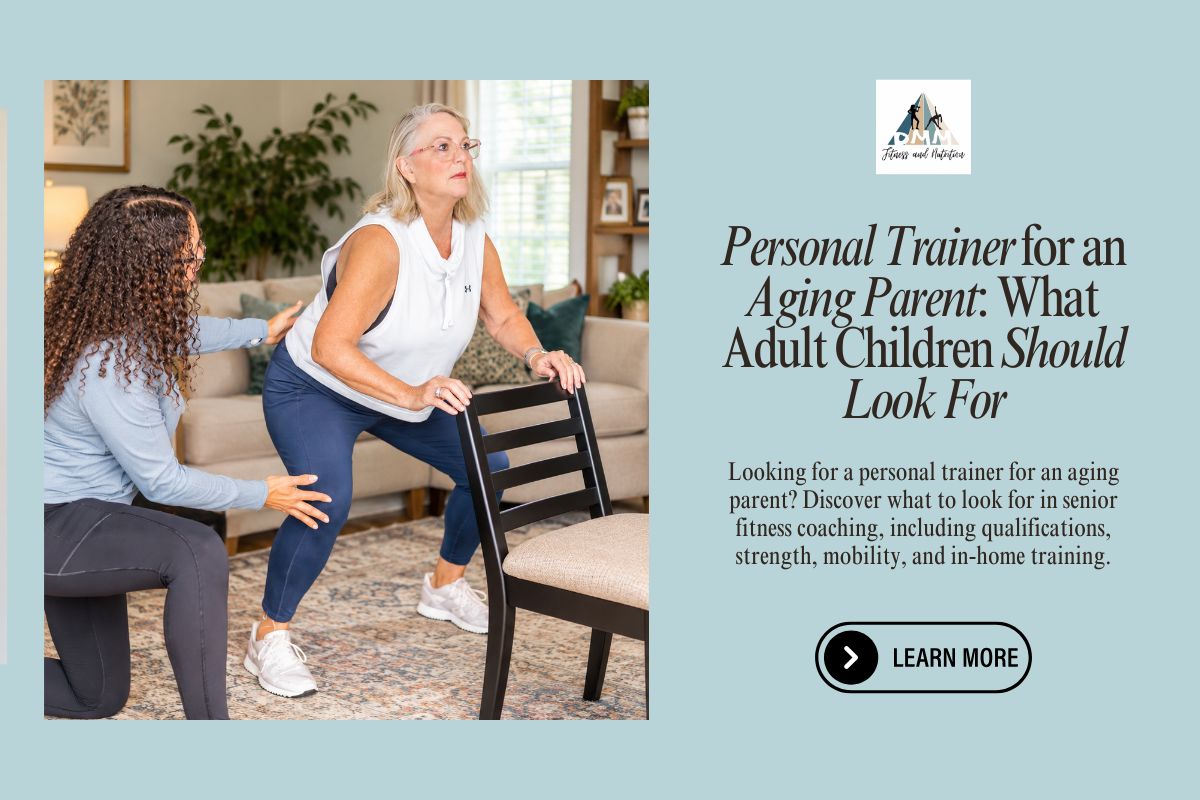
5. Consider a Personal Trainer Who Comes to Your Parent’s Home
One challenge families sometimes overlook is transportation.
Your parent may be interested in exercising but not want to drive to a gym several times each week.
They may feel uncomfortable in a crowded fitness center.
Or perhaps they simply prefer the privacy and convenience of exercising at home.
That’s why I offer one-on-one personal training that comes directly to the client.
Your parent doesn’t have to come to me. I come to them.
Private in-home personal training can offer several advantages:
- No need to travel to a gym
- Individual attention throughout the session
- Workouts adapted to the available space
- A familiar exercise environment
- Personalized instruction and guidance
- Scheduling that can be discussed around individual needs
And your parent doesn’t need an elaborate home gym.
We can discuss their available space, current equipment, abilities, and goals before determining what makes sense.
For families searching for in-home personal training for seniors in Augusta, Evans, Martinez, Grovetown, North Augusta, or surrounding CSRA communities, this can be a convenient alternative to traditional gym-based training.
6. Look for Patience, Communication, and Encouragement
Professional qualifications matter.
But so does the way a trainer communicates.
Some older adults feel confident beginning a new fitness program.
Others may feel nervous, uncertain, or uncomfortable because they haven’t exercised in a long time.
A good trainer should be willing to explain exercises, answer questions, demonstrate movements, and adjust the session when needed.
Your parent should feel comfortable communicating with their trainer.
They should also feel that their concerns and preferences are being heard.
When I work with someone, I want them to understand what we’re doing and why.
I believe a supportive training relationship should encourage confidence while still providing appropriate challenges.
Your parent should feel respected, not rushed or underestimated.
7. Find Someone Who Understands That Seniors Have Different Fitness Levels
One of the biggest misconceptions about senior fitness is that everyone over a certain age needs gentle, beginner-level exercise.
That simply isn’t true.
Some older adults have been exercising consistently for decades.
Others are beginning a structured fitness program for the first time.
One person in their 70s may enjoy strength training, traveling, and recreational sports.
Another may want to become more comfortable with basic movements.
Both deserve a fitness program that reflects their abilities.
When evaluating a personal trainer for older adults, ask how they adjust exercise difficulty.
Can they modify movements for beginners?
Can they provide appropriate challenges for active seniors?
Can they change resistance, repetitions, or exercises as someone progresses?
Age alone shouldn’t determine the workout.
8. Ask How Progress Will Be Evaluated
When people think about fitness progress, they often think about weight loss or changes in appearance.
But for older adults, progress can mean much more.
Depending on your parent’s goals, improvements may include:
- Becoming stronger during resistance exercises
- Performing movements with better technique
- Feeling more comfortable with exercise
- Improving balance or coordination
- Developing greater exercise consistency
- Increasing confidence with physical activities
- Being able to complete appropriately challenging workouts
Progress doesn’t always happen at the same pace for everyone.
And not every older adult has the same goals.
A trainer should help your parent recognize improvements that are meaningful to them.
9. Make Sure Your Parent Has a Say in the Decision
This is one of the most important things I want adult children to remember.
Your parent should be part of the conversation.
You may be the person researching personal trainers, comparing services, or helping arrange appointments.
But your parent is the person who will be exercising.
Their preferences matter.
Their comfort matters.
Their goals matter.
Before arranging personal training, talk with them about what they want.
Would they prefer private training at home?
Are they interested in group fitness?
Do they enjoy exercising with other people?
Would they feel more comfortable working individually with a trainer?
What activities would they like to keep doing as they age?
The goal shouldn’t be to pressure someone into exercise.
It should be to help them find an approach they feel comfortable participating in consistently.
10. Consider Private Training vs. Senior Fitness Classes
Not every older adult prefers the same exercise environment.
Some enjoy the social interaction of group fitness.
Others prefer individualized attention.
Private Personal Training for Seniors
Private training allows the session to focus on one person.
Exercises can be selected and adjusted according to the client’s abilities, experience, and goals.
This can be especially appealing to older adults who value privacy or want additional guidance.
Senior Fitness Classes
Group fitness offers opportunities for social interaction, shared motivation, and structured physical activity.
Senior centers, retirement communities, and senior living facilities may provide group fitness programs for their members or residents.
At DMM Fitness & Nutrition, I can also discuss bringing senior fitness classes and older-adult wellness programming directly to organizations throughout the CSRA.
The right choice depends on your parent’s preferences and needs.
Some older adults may even enjoy a combination of private training and group activities.
What Questions Should You Ask Before Hiring a Senior Personal Trainer?
If you’re comparing fitness professionals for an aging parent, I recommend asking a few important questions before making a decision.
1. What qualifications do you have for working with older adults?
Look for relevant training, education, and experience.
2. How do you determine the right exercises for each client?
The trainer should consider individual abilities, goals, and exercise experience.
3. Can you modify exercises when needed?
A personalized program should be adaptable.
4. Do you offer in-home personal training?
This can be important if your parent prefers exercising at home.
5. How often would you recommend training?
The answer should depend on your parent’s abilities, goals, and recovery needs rather than a predetermined schedule.
6. How do you help clients stay consistent?
Ask about scheduling, accountability, and progress.
7. Can family members participate in the initial conversation?
This can help adult children better understand the service while keeping the older adult involved in decisions.
These questions can help you identify a trainer whose approach aligns with your parent’s needs.
Personal Training for Aging Parents Throughout Augusta, Evans & the CSRA
If you’re looking for a personal trainer for seniors in Augusta, GA, or you’re helping an older parent find fitness support elsewhere in the CSRA, I provide personalized training designed around the individual.
My local service area includes:
- Augusta, Georgia
- Evans, Georgia
- Martinez, Georgia
- Grovetown, Georgia
- North Augusta, South Carolina
- Surrounding communities throughout the CSRA
I offer private personal training that comes directly to the client, making fitness more accessible for older adults who prefer exercising in a familiar environment.
I can also discuss fitness programming with senior centers, retirement communities, and senior living organizations interested in offering structured exercise opportunities.
You can learn more about my senior personal training for older adults throughout the CSRA.
Frequently Asked Questions About Hiring a Personal Trainer for an Aging Parent
Is a personal trainer a good idea for an elderly parent?
A qualified personal trainer can help an older adult participate in individualized exercise based on their current abilities, goals, and experience.
The right fit depends on your parent’s needs, preferences, and willingness to participate.
What is the difference between a regular personal trainer and a senior fitness specialist?
A senior fitness specialist has additional education focused on working with older adults.
This can include understanding age-related changes, appropriate exercise modifications, strength training, balance, mobility, and functional fitness.
Can a personal trainer work with someone in their 70s or 80s?
Yes. Many older adults in their 70s, 80s, and beyond can participate in appropriately designed fitness programs.
The exercises should reflect the individual’s abilities, experience, goals, and relevant health considerations.
Does my parent need to go to a gym?
No. I offer private mobile personal training and can come directly to clients throughout my CSRA service area.
What if my parent has never exercised before?
That’s okay. A beginner’s program can start with appropriate exercises and gradually progress as confidence and abilities develop.
How often should an older adult work with a personal trainer?
It depends on their current fitness level, goals, exercise experience, recovery, and schedule.
For a closer look at training frequency, read How Often Should You Meet With a Personal Trainer in Evans, GA to See Progress?.
Can I arrange personal training for my mother or father?
Yes. I welcome inquiries from adult children and family members researching fitness options for an older loved one.
I encourage families to include the person who will be exercising in the discussion about their goals and preferences.
Do you provide personal training for older adults in North Augusta, SC?
North Augusta is part of the CSRA communities I serve. Contact me with your location to discuss scheduling and mobile training availability.
Helping Your Aging Parent Stay Strong Starts With the Right Support
Finding a personal trainer for an aging parent isn’t simply about choosing someone who can demonstrate exercises.
It’s about finding a professional who understands older-adult fitness, respects individual abilities, communicates clearly, and creates a supportive training experience.
Your parent may want to build strength.
They may want to work on balance and mobility.
They may be returning to exercise after years away.
Or perhaps they simply want to continue enjoying the activities that make life meaningful.
Whatever their starting point, their fitness program should be designed around them—not just their age.
Looking for a Personal Trainer for Your Aging Parent in the CSRA?
I’m Doris Martinez, Master Trainer & Wellness Coach at DMM Fitness & Nutrition.
I provide personalized senior fitness training for older adults throughout Augusta, Evans, Martinez, Grovetown, North Augusta, and surrounding CSRA communities.
Whether you’re exploring personal training for your mother, father, spouse, or another loved one, I’d be happy to discuss how individualized fitness coaching works.
And remember: Your parent doesn’t have to come to me. I come to them.
Learn More About Senior Personal Training for Older Adults
DMM Fitness & Nutrition
Doris Martinez, Master Trainer & Wellness Coach
Phone: (915) 740-8622
Website: https://dmmfitnessandnutrition.com/