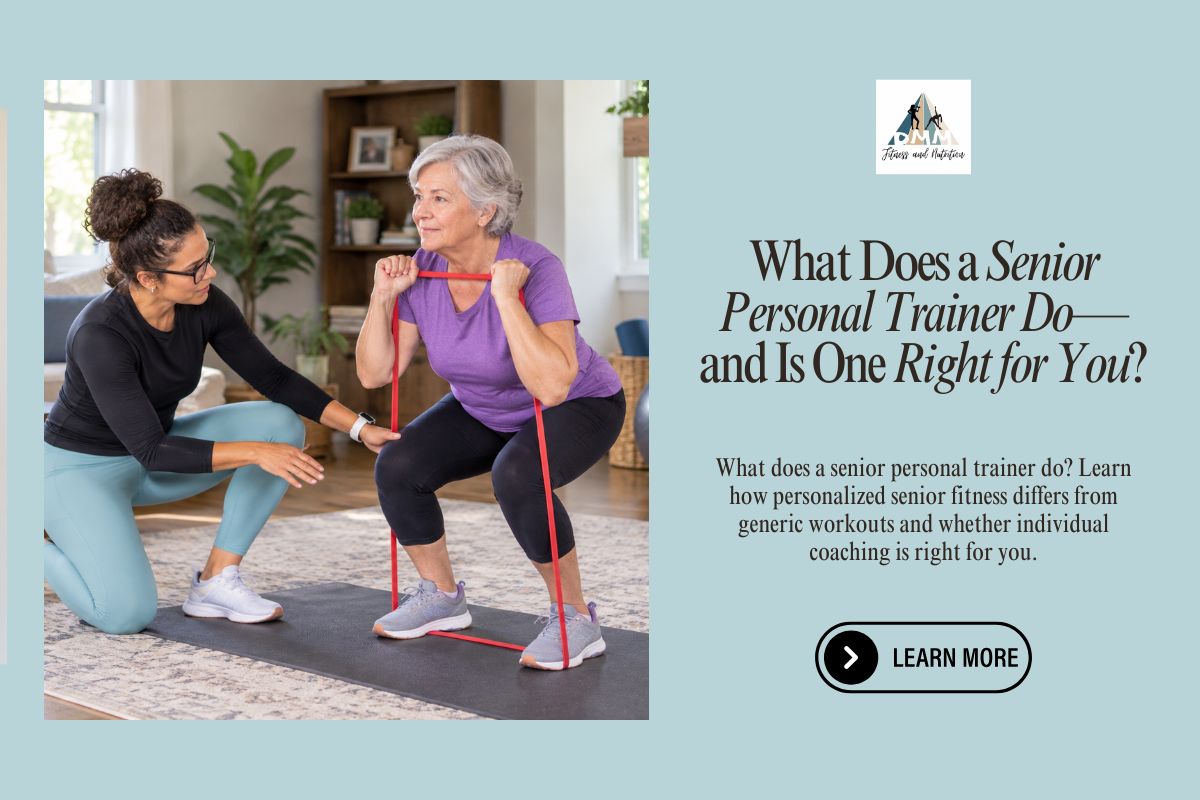
What Does a Senior Personal Trainer Do—and Is One Right for You?
Getting older doesn’t mean you suddenly need to stop challenging your body.
But it may mean that the way you exercise should become more thoughtful, individualized, and appropriate for where you are today.
Maybe you’ve exercised for decades and want to keep going safely and confidently. Maybe you haven’t worked out in years and aren’t sure where to begin. Or perhaps you’re searching for someone who can help your mother, father, spouse, or another older family member stay active.
That’s where working with a senior personal trainer can be different from simply downloading a workout, joining a gym, or following an exercise video.
I’m Doris Martinez, founder of DMM Fitness & Nutrition, and I believe senior fitness should start with the individual—not the number on someone’s birth certificate.
Let’s talk about what a senior personal trainer actually does, what makes senior-focused fitness different, and how to decide whether this type of coaching makes sense for you or someone you love.
What Is a Senior Personal Trainer?
A senior personal trainer is a fitness professional who works with older adults while considering their current abilities, fitness experience, goals, comfort level, and individual needs.
That’s important because the word “senior” describes an age group. It doesn’t tell us exactly what someone’s body can do.
One person in their 70s might exercise several times a week, travel frequently, garden, play golf, and have years of strength-training experience.
Another person the same age might be returning to structured exercise after being inactive for years.
Those two people shouldn’t automatically receive the same workout.
As a senior fitness specialist, my job isn’t to look at someone’s age and immediately decide what they can or cannot do.
I want to understand the person standing in front of me.
What Does a Senior Personal Trainer Actually Do?
Working with a personal trainer for seniors isn’t simply having someone stand beside you and count repetitions.
Personal training should be personal.
Before deciding what exercises make sense, I want to understand things such as:
- Your current fitness level
- Your exercise experience
- Your goals
- Activities you enjoy
- Your comfort with exercise
- Your available space and equipment
- Your schedule
- Areas where you may need more guidance
- What you’d like to continue being able to do in everyday life
From there, exercise can be selected and adjusted according to the individual.
Depending on your starting point and goals, training may incorporate areas such as strength, balance, mobility, flexibility, coordination, functional movement, and general fitness.
The purpose isn’t to squeeze every older adult into one predetermined “senior workout.”
It’s to create an appropriate starting point and build from there.
A Senior Fitness Specialist Doesn’t Assume Older Means Frail
This is something I think is particularly important.
Senior fitness should not automatically mean easy fitness.
Yes, some older adults need a gradual starting point.
Others are capable of considerably more.
If you’ve been active for years, you may need exercises that genuinely challenge you.
If you’re returning to fitness after a long break, we may start much more gradually.
Both approaches can be appropriate.
A senior fitness specialist should be able to recognize those differences.
I don’t believe someone’s age should automatically determine how challenging their workout is.
The appropriate challenge depends on the individual.
How Is Senior Personal Training Different From a Generic Workout?
There are thousands of workouts available online.
Some are excellent.
But there’s one thing a generic workout doesn’t know:
You.
A video doesn’t know your fitness history.
It doesn’t know whether you’ve been exercising consistently for 20 years or haven’t exercised in 20 years.
It can’t watch how you’re performing an exercise.
It doesn’t know whether an exercise feels too easy, too difficult, or simply isn’t appropriate for you.
And it can’t change the workout because you’re having a different kind of day than you expected.
When I work individually with someone, I can observe what’s happening.
I can demonstrate an exercise.
I can answer questions.
I can change resistance.
I can adjust repetitions.
I can modify a movement.
I can progress an exercise when you’re ready.
That individual attention is one of the biggest differences between following a generic routine and working with a personal trainer for older adults.
Strength Training Can Be an Important Part of Senior Fitness
When people hear “strength training,” they sometimes picture huge weights and bodybuilding.
That’s not what strength training has to look like.
Strength is involved in everyday life.
You use it when you stand up from a chair.
Carry groceries.
Climb stairs.
Pick something up.
Move things around your home.
Carry luggage.
Work in your garden.
Play with grandchildren.
Participate in hobbies.
That’s why I’ve previously discussed why strength training becomes more important as you get older.
Depending on the individual, strength exercises can use body weight, resistance bands, dumbbells, or other appropriate forms of resistance.
The objective isn’t necessarily to lift the biggest weight possible.
It’s to become stronger for your life.
What About Balance and Mobility?
Strength isn’t the only area that can matter as we age.
Balance, mobility, coordination, flexibility, and confidence in movement may also deserve attention.
Think about everyday situations.
Reaching for something.
Changing direction while walking.
Moving around furniture.
Getting up and down.
Walking over different surfaces.
Stepping around something in your path.
Your body constantly coordinates different types of movement.
That’s why senior-focused fitness can look at more than a single muscle or exercise.
Depending on your abilities and goals, I can incorporate different aspects of movement into your training.
The objective is not to promise that exercise will prevent every problem associated with aging.
It’s to help you continue working on your physical fitness in a way that makes sense for you.
Functional Fitness Means Training for Real Life
One phrase you may hear in senior fitness is functional fitness.
It sounds technical, but the basic idea is quite practical.
You’re training your body for the things you actually do.
A squat pattern, for example, has a connection to sitting down and standing up.
Carrying resistance has a connection to carrying everyday objects.
Strengthening your legs can have relevance to stairs and walking.
Core strength contributes to stability during many movements.
Your workout doesn’t exist only for the 30 or 60 minutes you’re exercising.
What matters is what your fitness helps you continue doing outside the workout.
Do You Need to Already Be Fit?
Absolutely not.
One of the biggest misconceptions about personal training is that you have to get in shape before hiring a trainer.
That’s like saying you have to learn everything before hiring a teacher.
You don’t need to prepare yourself for personal training.
Personal training should meet you at your current starting point.
If you’re a beginner, we start there.
If you’ve been exercising regularly, we start there.
If you’re somewhere in between, that’s where we start.
You don’t have to prove anything before your first session.
Is It Too Late to Start Exercising in Your 60s or 70s?
Your age alone doesn’t determine whether you can begin exercising.
What matters is finding an appropriate starting point based on your individual situation.
If you’re new to exercise later in life, you don’t have to jump immediately into an intense routine.
You can learn.
You can practice.
You can gradually build confidence.
You can become stronger.
And you can progress from where you are.
If you have a medical condition, recent injury or surgery, or concerns about beginning an exercise program, talk with your healthcare professional about what’s appropriate for you.
But don’t assume that simply having another birthday means fitness no longer belongs in your life.
What If You’ve Been Active Your Entire Life?
There’s another side of senior fitness that doesn’t receive enough attention.
Some older adults aren’t beginners at all.
Maybe you’ve been strength training for years.
Maybe you walk several miles regularly.
Maybe you play tennis, golf, pickleball, or another sport.
Maybe you travel frequently and lead an extremely active life.
You don’t necessarily need someone telling you to slow down simply because you’ve entered a particular age category.
You may need a program that continues challenging you appropriately while recognizing that your body and recovery needs can evolve over time.
That’s another reason individualized training matters.
Senior fitness isn’t one fitness level.
Personal Training Can Come to You
One of the biggest barriers to exercise isn’t always motivation.
Sometimes it’s logistics.
Driving to a gym.
Finding parking.
Dealing with crowds.
Waiting for equipment.
Feeling uncomfortable exercising around other people.
Or simply adding another trip to an already busy day.
That’s why my senior personal training for older adults offers another option.
I come to you.
You don’t need a room filled with gym equipment.
We can discuss your available space, what equipment you already have, your current abilities, and your goals.
For some older adults, exercising in a familiar environment can also make getting started feel much less intimidating.
Are You Looking for a Personal Trainer for an Aging Parent?
Sometimes the person searching for a trainer isn’t the person who will be exercising.
It’s an adult son or daughter.
Maybe you’ve noticed that your mother or father isn’t as active as they once were.
Maybe they’ve mentioned wanting to become stronger.
Maybe they’ve talked about exercising but don’t feel comfortable joining a traditional gym.
Or maybe you’d simply like them to have professional guidance rather than trying random workouts on their own.
If you’re searching for a personal trainer for older adults on behalf of a parent, I’d encourage you to look beyond someone’s list of exercises.
Ask how they approach older clients.
Do they individualize training?
Do they listen?
Can they explain exercises clearly?
Can they modify movements?
Do they understand that older adults can have dramatically different abilities?
And perhaps most importantly:
Will your parent feel comfortable working with them?
The relationship matters.
What Should You Look for in a Personal Trainer for Seniors?
Not every trainer has exactly the same background or approach.
If you’re considering a trainer for yourself or a family member, ask questions.
Find out about their experience and professional background.
Ask how they determine an appropriate starting point.
Ask how workouts are individualized.
Ask whether they work with beginners as well as active older adults.
Ask what happens if an exercise isn’t appropriate or comfortable.
Ask whether training requires a gym.
And pay attention to whether the trainer actually listens to what you want.
A good training relationship should involve communication.
You shouldn’t feel like you’re simply being handed somebody else’s workout.
Private Training or Senior Fitness Classes?
Both can have advantages.
A senior fitness class can provide community, social interaction, and the motivation that comes from exercising alongside other people.
Private personal training provides a different experience.
With one-on-one coaching, the session can focus specifically on you.
Your exercises.
Your pace.
Your questions.
Your abilities.
Your goals.
Some people strongly prefer one format.
Others may enjoy both.
Neither option has to be universally “better.”
The important thing is finding an environment that helps you participate consistently and appropriately.
How Often Should You Work With a Senior Personal Trainer?
There’s no single number that’s right for everyone.
How often you meet with a trainer can depend on your goals, experience, schedule, other physical activity, recovery, and how independently you exercise between sessions.
Some people benefit from more frequent guidance.
Others may work with a trainer while also exercising independently.
Consistency matters more than chasing somebody else’s perfect schedule.
I’ve discussed this more broadly in How Often Should You Meet With a Personal Trainer in Evans, GA to See Progress?.
The best schedule is one that’s appropriate for you and realistic enough to maintain.
Senior Fitness Is About More Than Exercise
I’m a Master Trainer & Wellness Coach, and I view fitness as one part of a larger wellness picture.
Your workouts matter.
But so do your daily habits.
Your nutrition.
Your recovery.
Your sleep.
Your everyday movement.
Your stress.
And your ability to remain consistent.
You don’t need to overhaul every aspect of your life at once.
Sometimes the most sustainable approach is identifying a few realistic changes and building from there.
Frequently Asked Questions About Senior Personal Training
What does a senior personal trainer do?
A senior personal trainer provides individualized fitness coaching for older adults. Depending on the client’s abilities and goals, training may incorporate strength, mobility, balance, flexibility, coordination, functional movement, and general fitness.
What is a senior fitness specialist?
A senior fitness specialist is a fitness professional with additional education focused on working with older adults. My background includes senior fitness along with personal training, corrective exercise, group fitness, nutrition, and wellness.
Is a personal trainer for seniors only for beginners?
No. Older adults have very different fitness levels. Some are beginners, while others have exercised consistently for decades. Training should reflect the individual rather than assuming everyone of a similar age needs the same workout.
Can a personal trainer work with someone in their 70s?
Age by itself doesn’t determine someone’s fitness program. Current abilities, experience, goals, health considerations, and other individual factors should be considered when determining an appropriate approach.
Does senior personal training have to take place in a gym?
No. With my personal training for seniors, I can bring private training directly to clients rather than requiring them to join a gym.
Do I need exercise equipment at home?
Not necessarily. We can discuss your available space, current equipment, abilities, and goals before determining what makes sense for your training.
Can I contact you about personal training for my parent?
Yes. Adult children and other family members are welcome to contact me to discuss whether private senior personal training may be appropriate for a parent or loved one.
Is strength training appropriate for older adults?
Strength training can be adapted for different ages and fitness levels. The exercises and resistance used should be appropriate for the individual’s abilities, experience, goals, and relevant health considerations.
So, Is a Senior Personal Trainer Right for You?
You may want to consider working with a senior personal trainer if you:
- Want to become stronger but aren’t sure where to start
- Prefer individualized guidance
- Want someone to observe and explain exercises
- Are returning to fitness after time away
- Don’t enjoy crowded gyms
- Want to exercise at home
- Want workouts adapted to your current abilities
- Would like more accountability
- Want to remain active as you get older
- Are looking for professional fitness support for an aging parent
You don’t have to fit every item on that list.
And hiring a trainer isn’t the only way to exercise successfully.
But if individual attention, guidance, convenience, and accountability would make fitness easier for you to maintain, personal training may be worth exploring.
Your Workout Should Be Based on You—Not Just Your Age
Getting older doesn’t mean giving up on becoming stronger.
It also doesn’t mean every workout has to become extremely easy.
What matters is finding the right challenge for your body today.
If you’re looking for a senior personal trainer, personal trainer for seniors, or personal trainer for older adults in the Evans, Georgia area, I’d love to talk with you.
At DMM Fitness & Nutrition, I’ll start by learning about you—your abilities, your experience, your goals, and what you’d like fitness to help you continue doing.
And because I offer private mobile training:
You don’t have to come to me. I come to you.
Learn more about Senior Personal Training for Older Adults.
DMM Fitness & Nutrition
Doris Martinez — Master Trainer & Wellness Coach
(915) 740-8622
[email protected]