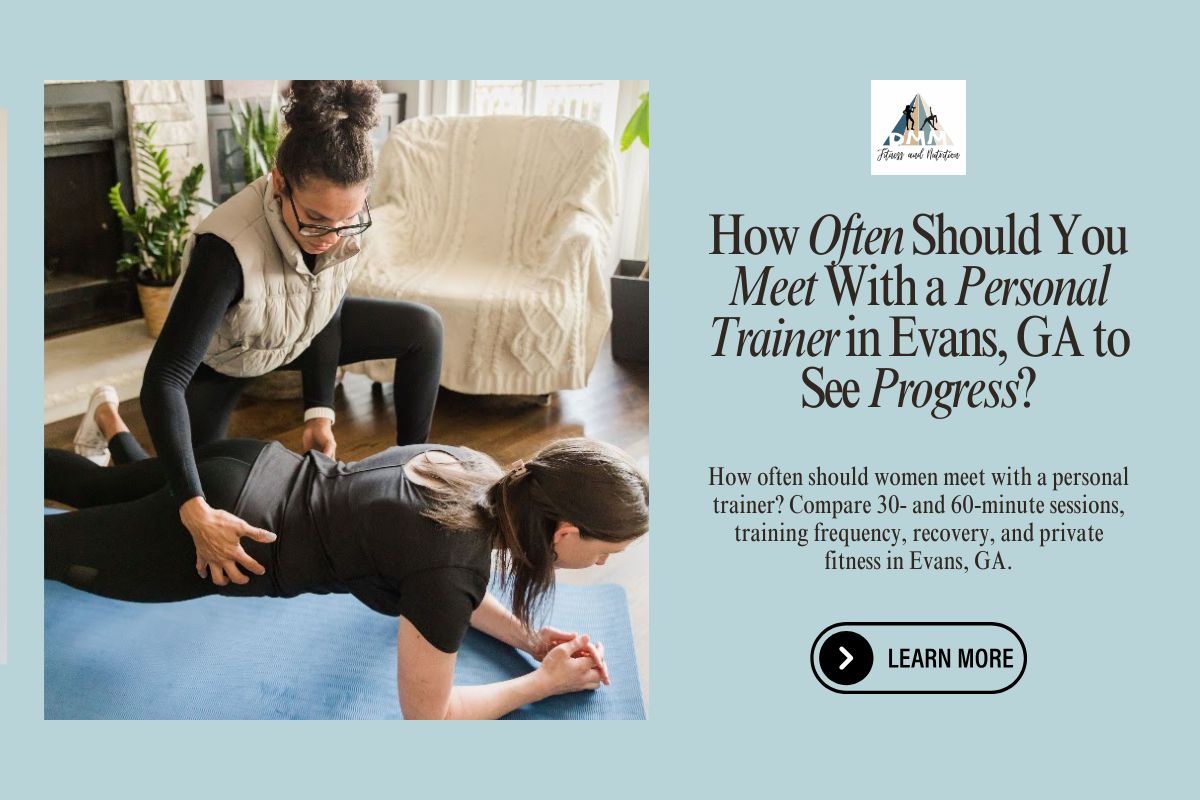
How Often Should You Meet With a Personal Trainer in Evans, GA to See Progress?
Once you’ve decided that personal training may be right for you, another question usually follows:
How often should I actually meet with my personal trainer?
Once a week? Twice a week? Three times? Is a focused 30-minute session enough, or should you schedule a full hour?
There isn’t one answer that’s right for every woman.
Your goals, current fitness level, exercise experience, schedule, recovery, and what you do between sessions all influence how often you may benefit from working with a trainer.
At DMM Fitness & Nutrition, Doris Martinez provides personalized one-on-one personal training for women in Evans, Georgia. And instead of requiring you to add another trip to the gym to your schedule, Doris comes to you.
If you’ve already read What to Expect From Your First Personal Training Session in Evans, GA, the next step is figuring out what kind of training schedule could realistically work for you.
The Short Answer: Consistency Matters More Than a Perfect Number
For many women, meeting with a personal trainer one to three times per week can be a practical range, depending on their goals, experience, schedule, recovery, and other physical activity.
But more isn’t automatically better.
A woman who consistently trains twice per week for months may get far more value from her routine than someone who commits to an unrealistic schedule and gives it up after a few weeks.
This principle applies whether you’re using private coaching, women’s fitness classes in Evans, GA, small group workouts, or exercising independently.
The better question isn’t simply:
“How many personal training sessions should I schedule?”
It’s:
“What training schedule can I realistically maintain?”
A sustainable approach to women’s fitness needs to work with your life if it’s going to become part of your life.
Is Personal Training Once a Week Enough?
For some women, once-a-week personal training can be a useful option.
It may work particularly well if you already exercise independently and want professional guidance, accountability, help with exercise technique, or a structured session to keep you moving in the right direction.
Your trainer can help you establish priorities while you continue walking, strength training, participating in fitness classes, or completing appropriate workouts independently.
However, if you’re brand new to exercise or have difficulty staying consistent when left on your own, you may benefit from more frequent coaching.
One personal training session per week also doesn’t mean you should only move your body once per week.
Think of your private session as one part of your overall women’s fitness routine.
Why Twice-a-Week Personal Training Can Work Well
For many busy women, two personal training sessions per week can provide a useful balance between structure and flexibility.
You’re working with your trainer regularly enough to reinforce exercise technique, maintain accountability, and gradually progress your workouts without having training appointments every day.
It also leaves room during the week for recovery and other types of activity.
For example, your routine could include two private training sessions along with walking, mobility work, recreational activity, or appropriate workouts you can perform independently.
For women who have struggled to maintain a routine on their own, having two scheduled appointments can also provide two consistent points of accountability during the week.
And because Doris comes to you, fitting those appointments into your schedule can be considerably different from making two additional trips to a gym every week.
What About Three Personal Training Sessions Per Week?
Three sessions per week may be appropriate for some women who want additional structure and whose goals, schedule, current fitness level, and recovery support it.
A beginner may appreciate more frequent guidance while learning movements and developing confidence.
Someone with specific strength or fitness goals may also prefer having more of her weekly exercise supervised.
But frequency should still be individualized.
Training three times per week isn’t inherently better than training twice per week.
The best schedule is the one that appropriately supports your goals while remaining sustainable.
30-Minute vs. 60-Minute Personal Training Sessions
Another common question is whether you need a full hour with a trainer to make your workout worthwhile.
Not necessarily.
Can a 30-Minute Personal Training Session Be Effective?
A focused 30-minute session can provide valuable coaching when the workout is structured around your goals, fitness level, and abilities.
Shorter sessions can be particularly attractive to busy women who want to make exercise a regular part of their week without feeling like fitness needs to consume their schedule.
DMM’s mobile approach also makes the time commitment different from traditional gym-based training.
Doris comes to you.
You’re not turning a 30-minute training appointment into an hour or more because you have to drive to a gym, park, wait, complete your session, and drive home.
For a busy professional, business owner, mother, caregiver, or woman juggling several responsibilities, that convenience can make consistency much easier.
When Might a 60-Minute Session Make Sense?
A 60-minute personal training session provides additional time and may allow for a broader workout depending on your goals and program.
Some women simply prefer having more time with their trainer.
Neither session length is automatically superior.
The appropriate choice depends on your goals, fitness level, desired level of coaching, schedule, and what you can realistically maintain.
Personal Training for Women Shouldn’t Be One-Size-Fits-All
This is one of the biggest advantages of private coaching.
Two women can be the same age and still have very different needs.
One woman may be completely new to exercise.
Another may already attend women’s fitness classes but want additional individualized strength training.
Someone else may be returning to exercise after years away.
Another may be in her 40s or 50s and increasingly interested in maintaining strength, muscle, mobility, and physical capability as she gets older.
That’s why personal training for women in Evans, GA should begin with the individual rather than a predetermined schedule.
Your training frequency should reflect your goals and circumstances, not somebody else’s.
How Your Fitness Level Influences Training Frequency
Someone beginning an exercise program after years of inactivity has different needs from someone who already exercises regularly.
Beginners may benefit from additional instruction as they learn exercise technique, become comfortable with resistance training, and establish a routine.
If you’re nervous about getting started, DMM’s Beginner’s Guide for Women to Overcome Common Fitness Fears can also help address some of the concerns that keep women from beginning.
More experienced women may be comfortable completing additional activity independently while meeting with Doris for coaching, progression, technique, and accountability.
That’s why the frequency of private personal training should be personalized.
Women’s Strength Training After 40
For many women, fitness goals begin to change in their 40s, 50s, and beyond.
The focus may shift from simply trying to burn calories toward maintaining or building strength, preserving muscle, supporting bone health, remaining active, and feeling physically capable in everyday life.
DMM has discussed why strength training is essential for women during perimenopause and beyond.
If you’re interested in fitness for women over 40, the goal shouldn’t necessarily be to exercise as frequently as possible.
A better approach considers:
Strength training.
Recovery.
Daily movement.
Nutrition.
Sleep.
Consistency.
Private coaching can help organize those pieces into an approach that makes sense for you.
Your Goals Influence How Often You Should Train
Training frequency should also reflect what you’re trying to accomplish.
A woman primarily looking to become more active may need a different routine from someone focused on developing strength.
Another woman may be using exercise as part of a broader healthy-aging strategy.
Someone else may primarily need accountability because she knows what to do but has difficulty doing it consistently.
That’s why your first conversations with a personal trainer matter.
Your goals help determine not only what you do during your sessions but how your overall week may be structured.
Don’t Forget About Recovery
It’s easy to assume that faster progress requires more exercise.
But training is only part of the equation.
Your body also needs opportunities to recover.
Sleep, hydration, nutrition, stress management, and appropriate rest between workouts all contribute to the bigger wellness picture.
This can become especially relevant as women move through their 30s, 40s, 50s, and beyond.
DMM’s guide to why recovery matters more after 35 explains why recovery deserves a place alongside exercise.
A good training schedule should provide an appropriate challenge while still recognizing the importance of recovery.
What You Do Between Personal Training Sessions Matters
Imagine two women who each meet with their personal trainer twice per week.
They could still experience very different progress.
Why?
Because fitness doesn’t exist only during those training appointments.
Your everyday habits matter.
That includes your overall movement, nutrition, hydration, sleep, recovery, stress, and consistency.
This is an important part of DMM Fitness & Nutrition’s approach because Doris isn’t only a fitness professional. She’s also a functional nutrition counselor.
That provides a broader perspective on women’s wellness and recognizes that exercise is only one part of supporting your goals.
Doris can also provide practical wellness guidance as part of the broader coaching relationship, helping women think about the habits surrounding their workouts rather than treating exercise as something completely separate from the rest of their lives.
For additional information about the nutrition side of the equation, read How a Nutrition Counselor in Georgia Can Maximize Your Fitness Results.
Why Having Your Personal Trainer Come to You Can Help With Consistency
Sometimes the biggest obstacle to exercising isn’t the workout itself.
It’s everything surrounding it.
Getting ready.
Driving to the gym.
Parking.
Waiting.
Completing the workout.
Driving home.
When you’re balancing work, family, appointments, and other responsibilities, those additional steps can turn a relatively short workout into a much bigger time commitment.
DMM’s one-on-one personal training removes much of that friction because Doris comes to you.
Instead of organizing your day around another trip to the gym, you can schedule focused private coaching where you are.
For women searching for a personal trainer in Evans, GA, that convenience is an important distinction.
Personal Training Doesn’t Have to Be Your Only Form of Exercise
Personal training for women doesn’t have to replace every other activity you enjoy.
Depending on your experience and program, your week might combine private coaching with walking, independent women’s strength training, women’s fitness classes in Evans, GA, small group training, or virtual fitness training.
Some women enjoy the community of a group class.
Others value the convenience of exercising virtually.
Some want the individual attention of private coaching.
And some may use a combination.
If you’re comparing those options, DMM’s guide to How to Choose the Right Women’s Fitness Class in Evans, GA can help you think through what level of coaching, flexibility, community, and personalization works best for you.
The objective isn’t to force every woman into the same type of fitness program.
It’s to build a routine you can actually maintain.
How Long Before You See Progress From Personal Training?
This is where realistic expectations are important.
Progress doesn’t happen on one universal timeline.
It also doesn’t always appear first on the scale.
You may initially notice that exercises feel more familiar.
Your technique may improve.
You may feel stronger.
You may become more consistent.
Activities that once felt difficult may begin to feel easier.
Over time, other changes may follow depending on your starting point, goals, training, nutrition, recovery, and consistency.
For women over 40 especially, it’s worth looking beyond body weight alone. DMM explores this further in Strength Beyond the Scale: Why Muscle Matters More Than Weight in Your 40s and Beyond.
The scale is only one possible measurement.
Strength, consistency, confidence, mobility, energy, and physical capability matter too.
Should You Add More Training Sessions if Progress Slows?
Not automatically.
When progress slows, simply adding more workouts isn’t always the solution.
There may be several things worth examining:
Your exercise program.
How consistently you’re following it.
Whether the workouts still provide an appropriate challenge.
Recovery.
Nutrition.
Sleep.
Stress.
Daily activity.
Sometimes the answer isn’t more training.
It’s better adjustment of the overall plan.
DMM’s guide to breaking through fitness plateaus explores some of the reasons progress can slow and what you can consider next.
One benefit of working privately with a trainer is that you don’t have to troubleshoot everything by yourself.
Private Personal Training vs. Women’s Fitness Classes
If you’re still deciding how much individualized support you need, consider the differences between private and group training.
A women’s fitness class can provide community, energy, motivation, and professional instruction.
Small group training can provide a middle ground between exercising alone and working completely one-on-one.
Private training provides the greatest opportunity for individual attention because the session is built specifically around you.
None of these options is automatically right for every woman.
The question is:
What type of environment helps you stay consistent and work toward your goals?
Your answer may even change as your fitness journey progresses.
How Do You Know Which Personal Training Schedule Is Right for You?
Consider four areas.
Your goals: What are you trying to accomplish?
Your experience: Are you comfortable exercising independently, or would you benefit from more guidance?
Your schedule: What can you realistically commit to week after week?
Your accountability: Are you likely to exercise without an appointment, or does knowing Doris is coming help you follow through?
Those answers provide much more useful information than simply copying another person’s training schedule.
Frequently Asked Questions About Personal Training Frequency
Is twice-a-week personal training enough?
For many women, twice-weekly private training can provide regular coaching and accountability while leaving room for recovery and other activity. Whether that’s appropriate for you depends on your goals, experience, and overall routine.
Can I see progress with a personal trainer once a week?
Once-weekly training can be useful, particularly if you remain active between sessions and are comfortable following appropriate exercise guidance independently. Progress depends on your overall routine, not simply the number of appointments on your calendar.
Are 30-minute personal training sessions worth it?
A focused 30-minute session can provide valuable exercise and individualized coaching. DMM’s approach also eliminates the additional time you’d normally spend traveling to and from a gym because Doris comes to you.
Is a 60-minute personal training session better than 30 minutes?
Not necessarily. A longer session provides additional training time, while a shorter session may be easier for some women to maintain consistently. Your program, goals, fitness level, and schedule should help determine which option makes sense.
How often should women over 40 strength train?
Training frequency should be individualized based on fitness level, goals, recovery, health considerations, and other activity. Rather than focusing solely on frequency, women over 40 can benefit from considering strength training as part of a broader routine that also includes appropriate recovery, nutrition, and regular movement.
Can I take women’s fitness classes and still have a personal trainer?
Yes. Private training and women’s fitness classes can serve different purposes. Some women may use one-on-one sessions for individualized coaching while enjoying group workouts for additional activity, variety, and community.
Can I combine personal training with virtual fitness?
Depending on your goals and overall program, you may be able to combine private coaching with virtual fitness training. This can give you individual attention during private sessions while maintaining additional flexibility during the rest of your week.
Does nutrition affect my fitness progress?
Nutrition is one part of the larger wellness picture alongside exercise, recovery, sleep, stress management, and consistency. Doris’s background as a functional nutrition counselor gives DMM a broader perspective on how these habits can work together.
Does Doris come to me for private personal training?
Yes. DMM’s private personal training model is built around Doris coming to the client, providing a convenient alternative to traveling to a traditional gym or studio.
Build a Women’s Fitness Routine You Can Actually Maintain
There’s no magic number of personal training sessions that guarantees progress.
For some women, once per week may provide the professional guidance they’re looking for.
For others, twice-weekly training can offer a practical balance of coaching, accountability, activity, and recovery.
Some women may benefit from additional sessions depending on their goals and circumstances.
And your routine doesn’t have to consist entirely of personal training.
Private coaching, women’s fitness classes, strength training, walking, small group workouts, and virtual fitness can potentially work together as parts of a broader plan.
The most important thing is creating an approach that is personalized, realistic, progressive, and sustainable.
At DMM Fitness & Nutrition, Doris Martinez provides one-on-one personal training for women in Evans, Georgia and comes to you, helping remove the additional time and inconvenience of traveling to and from a gym.
With her background in fitness and functional nutrition, Doris can also help women look at their wellness journey beyond the workout itself.
Ready to find out what training schedule fits your goals and lifestyle? Contact DMM Fitness & Nutrition and talk with Doris about private personal training, women’s fitness, and the level of support that’s right for you.