How to Choose the Right Women’s Fitness Class in Evans, GA
Choosing a fitness class can seem simple until you start looking at all the options.
Should you choose a large group class or small group training? Do you need strength training, cardio, or a combination? What if you’re a beginner? And how do you know whether a class will actually fit your goals rather than simply give you a good workout for an hour?
If you’re searching for women’s fitness classes in Evans, Georgia, the right class should be about more than convenience. It should provide an environment where you can learn, progress, build confidence, and develop a routine you can realistically maintain.
At DMM Fitness and Nutrition, I help women find an approach to fitness that works with their bodies, goals, and lifestyles—not against them.
If you’re considering joining a class, here are some of the most important things to look for.
1. Start With Your Fitness Goals
Before comparing fitness classes, ask yourself what you actually want to accomplish.
Your goals might include:
- Becoming stronger
- Improving mobility and flexibility
- Increasing energy
- Building or preserving muscle
- Improving overall fitness
- Creating a consistent exercise routine
- Getting back into exercise after time away
- Having more accountability
- Supporting your health as you move through your 40s and beyond
Different goals may require different approaches.
For example, if maintaining muscle and strength is important to you, a program that incorporates resistance training may make more sense than one focused almost entirely on cardio.
This becomes particularly relevant for women approaching or experiencing perimenopause. I’ve previously discussed why strength training is essential for women during perimenopause and beyond and how training needs can evolve during this stage of life.
The question shouldn’t simply be:
“Which class burns the most calories?”
A better question is:
“Which type of training supports what I want my body to be capable of doing?”
2. Consider the Size of the Fitness Class
Class size can have a major impact on your experience.
Large group fitness classes can provide plenty of energy and excitement, but they may offer less individual attention.
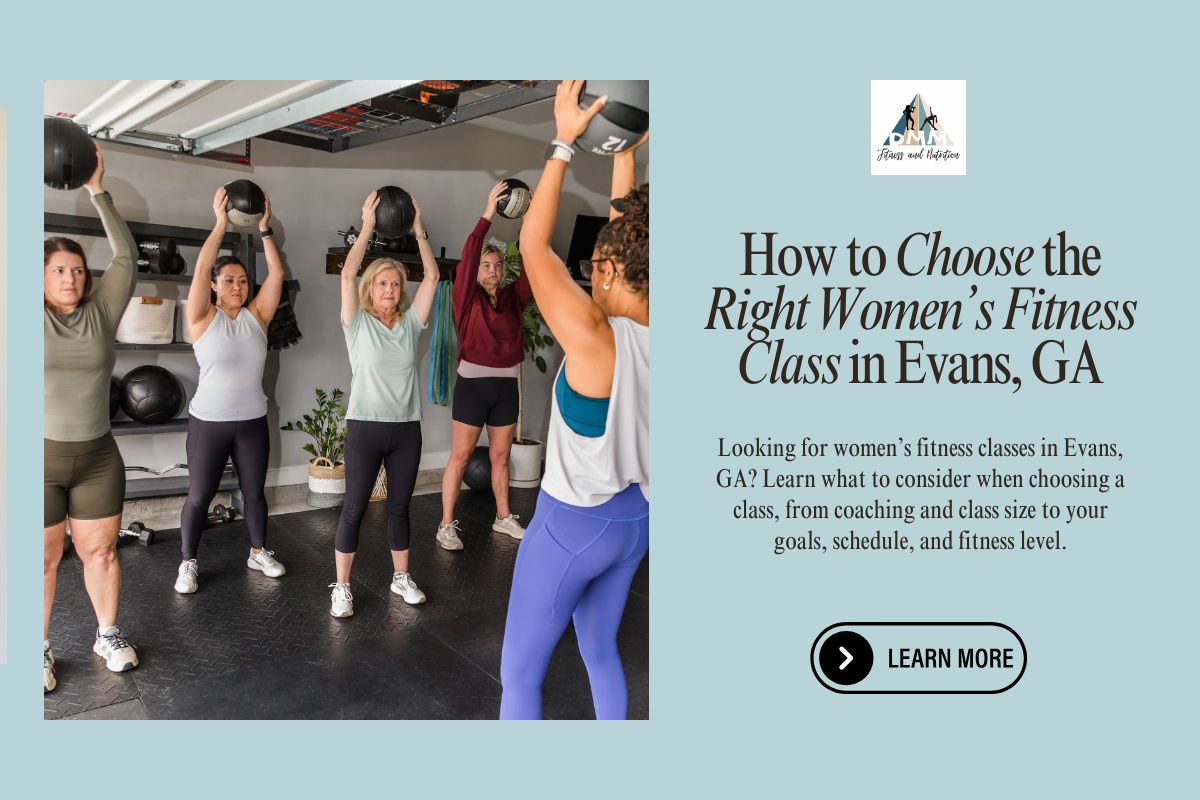
Small group training in Evans, Georgia can provide a different experience. You still benefit from exercising alongside other people, but a smaller environment can make it easier for your trainer to observe your movement, provide feedback, and make adjustments when appropriate.
There can also be an accountability benefit when you become familiar with the other women in your group.
I’ve explored this further in The Benefits of Small Group Training Over Solo Workouts.
When comparing classes, ask yourself:
How much individual attention am I likely to receive?
The answer can be especially important if you’re new to exercise or want more guidance than you’d typically receive in a large class.
3. Look for Professional Coaching, Not Just a Workout
There’s a difference between following exercises and being coached.
A good fitness professional isn’t simply there to tell you which exercise comes next.
Your trainer should help you understand proper movement, provide appropriate modifications, and create progression as you become stronger and more capable.
This can be particularly important for beginners.
Feeling uncertain about exercise is common. You might wonder whether you’re performing movements correctly, whether you’re using the appropriate resistance, or whether everyone else in the class is more experienced than you.
My Beginner’s Guide for Women to Overcome Common Fitness Fears addresses many of these concerns and explains why starting in the right environment can make such a difference.
A supportive fitness class shouldn’t make beginners feel as though they have to keep up with the most experienced person in the room.
It should help you progress from where you are today.
4. Make Sure the Workouts Can Be Modified
Women don’t all walk into a fitness class with the same background, ability, or experience.
One woman may have exercised consistently for years.
Another may be returning after a long break.
Someone else may be completely new to structured exercise.
That’s why modifications matter.
A well-designed fitness class for women in Evans, Georgia should allow exercises to be adjusted based on individual ability and experience rather than expecting everyone to perform exactly the same movement at exactly the same intensity.
Progress also doesn’t mean pushing harder every single day.
Recovery, mobility, consistency, and appropriate progression all matter.
As I explain in Why Recovery Matters More After 35: Rest, Repair, and Results, recovery is part of building sustainable fitness—not something separate from your fitness program.
5. Find a Schedule You Can Actually Maintain
The perfect fitness class won’t help much if you can rarely attend it.
Before joining, look honestly at your weekly schedule.
When can you realistically exercise?
Not during your imaginary perfect week.
During your actual week.
If mornings work best, an early morning fitness class may help you complete your workout before work, family responsibilities, appointments, and other commitments begin competing for your attention.
Consistency is usually more valuable than finding a theoretically perfect program that doesn’t fit into your life.
And if work, family, or travel makes attending an in-person class difficult, virtual fitness training can provide another option.
I recently explored 5 Reasons Busy Women Love Virtual Fitness Classes, including how removing the commute can make exercise easier to incorporate into a busy schedule.
The best training format is ultimately one you can consistently use.
6. Pay Attention to the Environment and Community
The atmosphere of a fitness class matters more than people sometimes realize.
Before committing, ask yourself:
- Do I feel comfortable here?
- Can I ask questions?
- Does the trainer know who I am and understand my goals?
- Do people encourage one another?
- Can I work at an appropriate level for me?
- Do I feel pressured to compete, or am I encouraged to make progress?
For many women, community becomes one of the reasons they continue showing up.
I explored this idea in Stronger Together: Group Training as Self-Care for Women Over 40, where I discuss how group training can combine physical activity with connection, encouragement, and accountability.
A supportive fitness community can turn exercise from something you feel obligated to do into something you genuinely look forward to.
7. Consider the Trainer’s Qualifications and Approach
Don’t be afraid to learn about the person who will actually be coaching you.
Certifications and professional education matter, but so does the trainer’s approach.
Does the trainer understand different fitness levels?
Do they emphasize proper movement and technique?
Can they adapt exercises?
Do they understand strength, mobility, flexibility, and recovery rather than focusing on only one aspect of fitness?
And perhaps most importantly:
Do they listen to you?
Working with a personal fitness trainer in Evans, Georgia should feel personal.
At DMM Fitness and Nutrition, my background includes athletic training, personal training, stretching and flexibility, group fitness, corrective exercise, and holistic nutrition.
That broader perspective allows fitness to be approached as more than simply completing a list of exercises.
8. Consider Whether the Program Looks Beyond Exercise
Your workouts matter, but they’re only one part of your overall wellness.
Nutrition, sleep, stress, hydration, recovery, and consistency can all influence how you feel and how well you progress.
That’s why it can be valuable to choose a fitness environment that recognizes the bigger picture.
For example, I’ve previously discussed how a nutrition counselor can maximize your fitness results and why exercise and nutrition work best when they’re considered together.
You don’t need to change everything at once.
But having support that recognizes the relationship between movement, nutrition, and recovery can help you gradually build healthier habits as a whole.
9. Decide Whether You Need Accountability
Knowing what exercises to do isn’t always the biggest challenge.
Actually doing them consistently can be.
You can download workout plans, watch exercise videos, and save dozens of fitness routines to your phone.
But none of those automatically creates accountability.
A structured class gives your workout a place on your schedule.
Small group training can add another layer because other people begin to notice when you’re there—and when you’re not.
Working with a trainer also means someone is helping you follow a structured plan rather than starting over every few weeks.
If consistency has been difficult in the past, don’t automatically assume you need more willpower.
You may simply need more structure and accountability.
10. Think About What Will Keep You Coming Back
This may be the most important consideration of all.
A workout program only works if you continue doing it.
You don’t have to love every squat, lunge, or challenging set.
But you should feel that the overall experience is worthwhile.
You should be able to see progress.
You should feel supported.
And the program should be realistic enough that exercise can become part of your normal life rather than something you repeatedly start and stop.
The goal isn’t perfection.
It’s building a routine you can continue.
Questions to Ask Before Joining a Women’s Fitness Class
Before signing up for a program, consider asking:
- What fitness levels is the class designed for?
- How large are the classes?
- Does the program include strength training?
- Can exercises be modified for beginners?
- How does the trainer help participants progress?
- What qualifications and experience does the trainer have?
- What happens if I need a modification?
- Are there options if I can’t attend in person?
- Does the program provide accountability?
- Is nutrition or wellness guidance available?
- Does the schedule realistically work with my life?
These questions can tell you much more than the class name or workout description alone.
Finding the Right Women’s Fitness Class in Evans, Georgia
Ultimately, choosing the right class isn’t about finding the trendiest workout or the program that promises the fastest transformation.
It’s about finding an environment where you can show up consistently, receive appropriate guidance, build strength, and make progress toward goals that actually matter to you.
For some women, that may mean small group training.
Others may prefer personal training.
And women who need greater scheduling or location flexibility may find virtual coaching more practical.
Your needs can also change as your fitness level, schedule, and goals evolve.
At DMM Fitness and Nutrition, I offer fitness and wellness support for women in Evans, Georgia, with options designed to help you build strength, confidence, and sustainable healthy habits.
Rather than trying to force yourself into a workout program, look for a program that can meet you where you are and help you move forward.
Ready to Find the Right Fitness Program?
If you’ve been searching for women’s fitness classes in Evans, GA, don’t choose based only on which class happens to be closest or which workout sounds the hardest.
Think about your goals.
Consider the coaching.
Look at the class environment.
Make sure the schedule works.
And choose an approach you can realistically see yourself continuing.
Explore DMM Fitness and Nutrition’s training options and find an approach that fits your goals, fitness level, and lifestyle.
Your fitness journey doesn’t have to look like anyone else’s. It simply needs to be one you can keep moving forward with.
Frequently Asked Questions About Women’s Fitness Classes in Evans, GA
What should I look for in a women’s fitness class in Evans, GA?
Look for qualified coaching, appropriate class sizes, exercise modifications, a supportive environment, convenient scheduling, and programming that matches your individual goals and current fitness level. The best class isn’t necessarily the hardest—it is one that allows you to progress safely and consistently.
Are women’s fitness classes suitable for beginners?
Yes. Beginners should look for classes where exercises can be modified and the trainer provides guidance on technique and progression. You don’t need to “get fit first” before joining the right fitness class.
Is small group training better than a large fitness class?
It depends on what you need. Small group training can combine the motivation and social benefits of exercising with other people with more individualized coaching than you would typically receive in a large class.
Should women over 40 include strength training?
Strength training can be particularly valuable for women in their 40s and beyond because maintaining muscle and strength becomes increasingly important as we age. I’ve discussed this further in Strength Beyond the Scale: Why Muscle Matters More Than Weight in Your 40s and Beyond.
What if I can’t attend fitness classes in Evans consistently?
If work, travel, family responsibilities, or a changing schedule make regular in-person attendance difficult, virtual training may give you greater flexibility while still providing structure and professional guidance.
How do I know which DMM Fitness and Nutrition program is right for me?
Start with your goals, current fitness level, schedule, and preferred training environment. From there, you can determine whether women’s fitness classes, small group training, personal training, or virtual fitness training provide the best fit for your lifestyle.